By Declan Maddox
As an Amazon Associate I earn from qualifying purchases. This page may contain affiliate links.
Yes, you can buy yoga blocks in bulk, and it usually makes sense for studios, teachers, and households that share props across several people. The main things to settle first are the material, the exact dimensions, and whether the set will be used for daily home practice or heavy group classes. Getting those right prevents an order of fifty blocks that nobody wants to use.
Why buyers choose yoga blocks in bulk
Buying in quantity makes the most sense when a space needs the same prop for many bodies at once. A group class of twelve students, for example, typically wants at least one block per person, plus spares for breakage and wear. Teachers running recurring classes often find that a single matched set keeps alignment cues consistent, because every student is working from the same height and width. Yoga Blocks Explained covers the basic shapes and uses if you are still deciding what the props are for.
Bulk buying also simplifies storage. Matching blocks stack neatly, and a uniform set looks orderly in a studio cubby or a home closet.
The factors that matter most before you order
Several details decide whether a bulk order works out. Check each one before you commit to a quantity.
Material and density
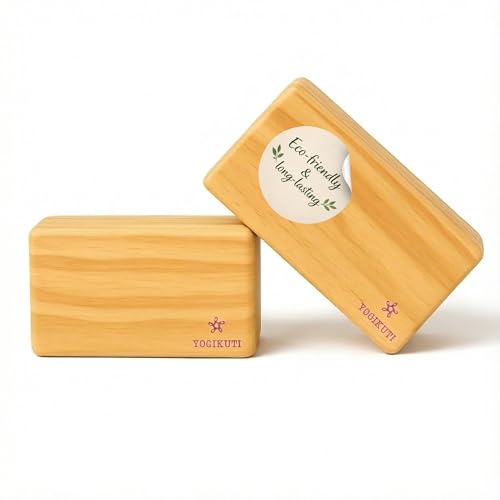
Foam, cork, and wood behave very differently under daily use. Foam is light and forgiving but can compress or crumble over time. Cork is firmer and more stable, and wood is the most durable but also the heaviest. Yoga Block Materials Compared walks through the tradeoffs in more detail. If your students include beginners who need extra support, density matters more than color or branding.
Dimensions
The most common standard is about 9 inches long by 6 inches wide by 4 inches high, though some manufacturers offer slightly different sizes or a lower “beginner” height. Before you buy, confirm the measurements printed in the product specifications, and consider whether you need a mix. Many teachers keep a few taller or narrower blocks for specific poses. For a closer look at shape differences, see Foam vs Cork Yoga Blocks (2026): Which Is Better for Your Practice?.
Weight and handling
If blocks will be carried between a storage room and a studio floor, weight is a practical concern. A set of twenty dense wood blocks is far heavier than the same count in foam. Manufacturers usually list weight per unit, so multiply that figure by your quantity to estimate how much you will be lifting.
Finish, cleanability, and grip
Matte finishes grip better than glossy ones, which matters for balance poses. Closed-cell foam and sealed cork wipe clean more easily than porous materials. In group settings, a surface that can be wiped down between classes saves time and keeps the props hygienic.
Shipping and returns
Bulk orders are bulky, even when the items themselves are light. Check whether the seller ships multi-unit orders in a single package, whether they can split a shipment, and what their return policy looks like for damaged or mismatched items. Ask about defect coverage in writing before you place a large order.
What to do about it: a simple ordering process
A clear process keeps a bulk purchase from turning into a mistake. Follow these steps.
- Count your actual users. Multiply the number of students per class by the number of classes you run in a typical week, then add 10 to 20 percent for replacement stock.
- Choose one material for the whole set so that heights and textures match across the group.
- Order one sample of the exact model first. Test its firmness and dimensions against your needs before buying the full quantity.
- Confirm the specifications in writing, including length, width, height, and weight per block.
- Check the warranty and what happens if a block arrives cracked or undersized.
- Label or color-code the set if several instructors share it, so blocks do not wander between rooms.
If you teach a lot of seated or restorative work, you may also want to pair blocks with other props. Yoga Props Buying Guide explains how blocks, straps, and bolsters fit together, and Yoga Straps Explained covers the strap side of the equation.
Tips for groups and studios
- Buy a few extra blocks beyond your headcount, since drops and wear happen.
- Keep one consistent material per room so instructors can give the same cues.
- Store blocks flat or upright on shelves rather than in a heap, which can dent or chip them.
- Wipe blocks down regularly, especially foam, which can hold sweat.
- Track which blocks are damaged and retire them before they become a safety issue.
For classes held in limited space, Yoga in Small Spaces offers layout ideas that also help with block storage.
What we’d use
For a durable, uniform set that handles frequent group use well, look for a high-density foam or cork block from an established yoga prop brand, sold in multi-packs. Choose a matte finish and confirm the exact dimensions before committing to quantity.
If you need blocks for a shared home practice rather than a studio, a smaller multi-pack of the same material keeps the household consistent without overbuying. View on Amazon
For studios that prefer a firmer, longer-lasting option, a set of solid cork blocks offers stability and a grippy surface. View on Amazon
Related questions
Are foam or cork blocks better for bulk orders?
Foam is lighter and cheaper to ship, while cork is firmer and holds its shape longer under heavy use. For a busy studio, many teachers prefer cork for durability. For a small group with mixed experience, foam can be easier to handle.
How many yoga blocks does a class need?
A common rule is two blocks per student for classes that use blocks in most poses, and one per student for lighter use. Add a few spares for breakage.
Can I mix block sizes in one order?
You can, but mixing materials or heights makes cueing harder. If you want variety, order sizes that share the same material and finish.
Should I buy a sample before a bulk order?
Yes. Testing one block lets you check density, dimensions, and finish against your actual needs before you commit to a large quantity. If you have questions about the right type for your students, a qualified yoga teacher or prop specialist can help you choose.

About Declan Maddox
Declan puts together our yoga guides, digging through specifications, manufacturer details and owner reviews so you don't have to.