By Declan Maddox
As an Amazon Associate I earn from qualifying purchases. This page may contain affiliate links.
You do not strictly need yoga blocks to practice, but a yoga blocks and mat combination makes many poses more accessible, especially if you are new, flexible or working on a specific alignment goal. Blocks bring the floor closer to your hands, while a grippy mat gives you a stable surface to press against. Together they support better form without requiring a larger budget or a dedicated studio.
Why blocks and a mat work well together
A mat defines your space and keeps your hands and feet from slipping. Blocks extend your reach. In standing poses like Triangle (Trikonasana) or Half Moon (Ardha Chandrasana), a block placed under the hand shortens the distance to the floor so you can keep the spine long and the hips open instead of collapsing forward. In seated poses like Seated Forward Fold (Paschimottanasana), a block under each sit bone can tilt the pelvis forward, which makes it easier to lengthen the spine instead of rounding it.
Shopping for one? See our guide: Foam vs Cork Yoga Blocks (2026): Which Is Better for Your Practice?.
Many instructors describe the pairing as a way to create the same shape with less strain. The mat protects you from hard floors and the blocks change the geometry of the pose. That combination matters most in restorative and gentle sequences, where you want to stay in a position for several minutes without gripping or forcing.
Factors that affect how well the setup works
Several details determine whether your yoga blocks and mat setup actually helps.
- Mat thickness. A thick mat (around 6 mm or more) cushions the knees and wrists but can make balance poses wobbly. A thinner mat of about 3 to 5 mm gives better ground feel. The Yoga Mat Thickness Guide covers the tradeoffs in more detail.
- Mat grip. A mat that slides when you sweat will undermine any prop you place on it. Look for a textured surface rather than a glossy one.
- Block material and size. Standard blocks are commonly listed at about 9 by 6 by 4 inches. Foam blocks are light and soft; cork and wood are firmer and more stable under load. The Yoga Block Materials Compared article breaks down the differences.
- Floor surface. On a hardwood floor, a mat plus blocks may slide. A non-slip mat under the blocks helps, or you can place the blocks on a folded towel.
- Room size. If you practice in a small space, blocks stored upright take less room than a rolled mat with a bulky bag. The Yoga in Small Spaces guide has storage ideas.
How to set up blocks on your mat
Placing blocks correctly takes a few seconds and prevents most of the common problems people report, like the block tipping or the hand skidding off.
- Roll out your mat and check that it lies flat with no curled edges.
- Set the block on the mat, not at the edge, so the full base contacts the surface.
- Choose the height first. For a standing pose, start on the lowest setting (one block) and raise to two or three blocks as needed.
- Press lightly on the block before weighting it to confirm it does not shift.
- If a block slides, place it on a folded towel or switch to a mat with more grip.
Practical tips for using blocks and a mat at home
- Begin with one block in standing poses and move to two only when you can keep your spine long.
- Use blocks under the sitting bones in seated forward folds, especially if your hamstrings are tight.
- In supported bridge, place a block under the sacrum at the lowest height to support the hips.
- Wipe blocks and the mat after practice, following the cleaning instructions the manufacturer gives.
- If you have a knee, wrist or back condition, consult a physical therapist or qualified instructor before adding props to a routine.
What we’d use
These are types of gear that suit a yoga blocks and mat setup. Check current availability and specifications before you buy.
- Lululemon The Reversible Mat 5mm is a grippy, moderate-thickness option that pairs well with standard blocks. View on Amazon
- Gaiam Essentials Thick Yoga Mat Fitness and Exercise Mat is a cushioned choice for practitioners who prioritize knee comfort. View on Amazon
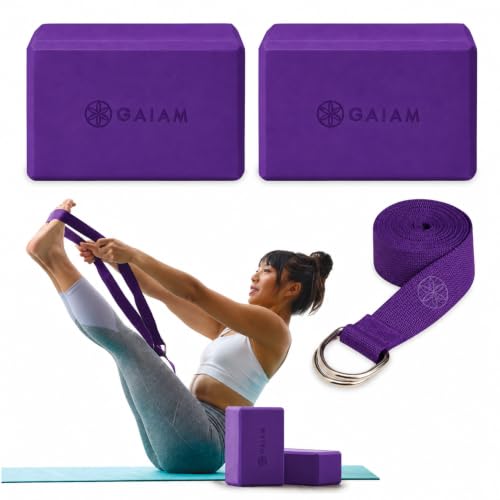
- Gaiam Yoga Block Essentials Foam Brick is a lightweight foam block that is easy to store and suits beginners. View on Amazon
Related questions
Do I need two yoga blocks or is one enough?
One block is enough for most beginners and many standing poses. Two blocks give more height for poses like Triangle or seated support, and some teachers recommend having a pair so you can use both sides evenly.
Can I use a towel instead of a block?
A rolled or folded towel can stand in for a block in a pinch, especially for seated support. It compresses more over time, so it is less reliable for weight-bearing poses. See the Yoga Towels guide for specifics.
Should blocks go on top of the mat or underneath it?
Place blocks on top of the mat. Putting them underneath creates an unstable surface and can cause the mat to bunch.
Are foam or cork blocks better for a yoga blocks and mat routine?
Foam is lighter and softer; cork is firmer and more stable under heavier loads. The Foam vs Cork Yoga Blocks (2026): Which Is Better for Your Practice? article compares them in depth.
Where can I learn more about yoga props?
The Yoga Props Buying Guide covers blocks, straps and other supports. For a broader look at equipment, see Best Yoga Mats and Best Yoga Blocks.
Related reading
- Yoga Blocks Explained
- Yoga Block Materials Compared
- Cork Blocks for Yoga: 5 Best Picks Compared (2026)
- Best Yoga Blocks
- Yoga Mats for Beginners
- Yoga Mat Thickness Guide

About Declan Maddox
Declan puts together our yoga guides, digging through specifications, manufacturer details and owner reviews so you don't have to.