
 By Lauren Holland
Updated November 2026
Chair yoga charts are a simple way to bring living arts yoga for beginners into a home space without a studio membership or a full set of equipment. This unframed 12×18 inch laminated poster, listed as a Chair Yoga Chart Exercise Poster with seated exercises for seniors and beginners, is aimed at people who want a visual reminder of gentle seated movements to follow on their own. It suits older adults, people recovering from limited mobility, caregivers who lead small group sessions, and anyone who learns better by looking at a picture than by reading a long article. It is a poor choice for people who want guided video, verbal cues, or a structured progression that builds week to week. If you need someone to correct your alignment or explain breathing in real time, a printed chart will not do that job.
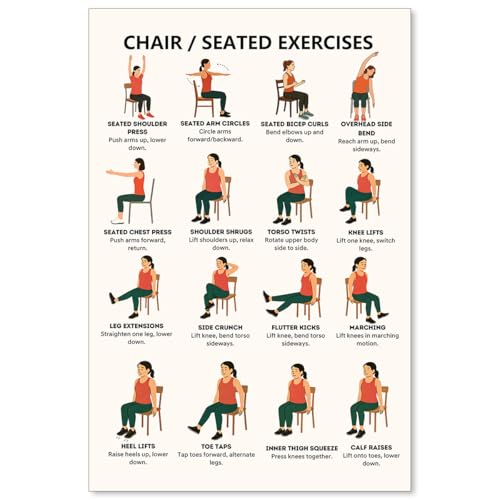
Chair Yoga Chart Exercise Poster Seated Exercises for Seniors and Beginners Canvas Wall Art Gym Yoga Room Living Room Bedroom Decor 12×18 Inch Unframed Laminated Gentle Seated Exercise Charts Print
Product Overview
This product is a printed wall chart designed around seated yoga and gentle exercise. Based on the listing name, it is an unframed print on canvas-style material, sized 12 by 18 inches, and described as laminated. The chart is marketed for seniors, beginners, and people who want to exercise while sitting, and the listing positions it as decor for a living room, bedroom, yoga room, or gym corner. In other words, it does double duty: it is meant to be seen every day and used as a reference during practice.
The core idea is simple. Each chart shows a set of seated movements, usually with a small illustration of the pose and a short label. The user sits in a sturdy chair, follows the pictured movement, and repeats it at a comfortable pace. This approach is well suited to people who cannot easily get down to the floor, and it removes the intimidation that many beginners feel in a crowded class. The format is also low-tech, which some users prefer over tablets, streaming apps, or sign-in pages.
Because the product is a static print, its value depends almost entirely on how clear the illustrations are and how well the chosen exercises match your current ability. It does not adapt to your level, it does not count repetitions, and it does not show you how to modify a pose if something feels wrong. Keep that in mind as you read the rest of this review.
Key Features & Specifications
The table below lists only the specifications that are clearly stated in the product name or are standard for this type of printed chart. Where the listing does not confirm a detail, it is left out.
| Feature | Details |
|---|---|
| Product type | Chair yoga and seated exercise wall chart |
| Dimensions | 12 x 18 inches |
| Format | Unframed print |
| Surface | Canvas wall art style, described as laminated |
| Intended users | Seniors and beginners |
| Intended setting | Living room, bedroom, yoga room, gym |
| Content | Gentle seated exercise charts |
The unframed format matters. You will need a frame or a simple way to hang the sheet, and you should measure your wall space before ordering. A 12 by 18 inch print is small enough for a bedside or a narrow hallway, but it may look modest above a sofa. Laminated sheets are easier to wipe clean, which helps if the chart sits near a kitchen or is handled often.
Pros & Cons
Pros
- Seated format makes it accessible for people who cannot easily get down to the floor.
- Pictures give a visual reference that many beginners find easier than written instructions.
- Compact 12 by 18 inch size fits small rooms, bedsides, and shared spaces.
- Laminated surface is reported by owners to be easier to clean than uncoated prints.
- Works as both wall decor and a practical exercise reference.
- No screen, login, or subscription needed once the chart is hung.
Cons
- Static image with no audio, pacing, or live correction.
- Does not explain breathing, alignment, or how to modify a pose that feels too hard.
- Unframed, so an additional frame or hanging hardware is needed.
- Small print may be hard to read from across a large room.
- No built-in progression; the user must decide what to practice and when.
Performance Analysis
Because this is a printed chart rather than a powered device, “performance” here means how well the chart supports a safe, consistent practice. Owners of similar seated charts commonly report that the main benefit is convenience: the chart is always visible, so it prompts short sessions during the day rather than waiting for a scheduled class. That habit is often more valuable for beginners than any single pose.
The quality of the illustrations is the biggest variable. Clear line drawings with arrows or simple labels tend to work best. Busy or very small images make it harder to tell where the hands and feet should go, and beginners may guess incorrectly. If the poses on your chart are small or crowded, consider printing a larger copy or using a magnifier when you first learn each movement.
The laminated surface should resist scuffs and light moisture, which helps when the chart sits in a kitchen, craft room, or near a bathroom door. Canvas-style prints can look softer on the wall and may suit a living room better, though they can be less easy to wipe. Keep the chart out of direct sun to reduce fading over time.
In terms of exercise value, any seated routine is limited compared with a full floor practice. A chair-based set typically focuses on mobility of the spine, shoulders, hips, and ankles, along with gentle breath work. It will not build significant strength or balance on its own. Users who want more challenge will eventually need to add standing or floor work, or follow a structured sequence elsewhere.
Safety is the other key point. A chart cannot tell you whether a movement is right for your body. If you have heart disease, recent surgery, osteoporosis, balance problems, or joint pain, speak with your doctor or a qualified physical therapist before starting any new exercise routine, and stop immediately if you feel chest pain, dizziness, or sharp pain.
Who Should Buy This Product?
This product is a good fit if you already have a basic idea of what seated yoga involves and want a visual cue to practice regularly. It works well for older adults who prefer paper references, for people setting up a small home practice space, and for caregivers who want an easy reminder to lead gentle movement with a group or family member. It also suits anyone who wants low-cost decor that doubles as a useful tool.
You should skip it if you are a complete beginner who needs verbal instruction, if you have a medical condition that requires individual guidance, or if you want a progression that builds in difficulty. In those cases, a video program, a live class, or a book with detailed text will serve you better. A chart is a reminder, not a teacher.
Buying Guide
When choosing a seated yoga or exercise chart, look for five things. First, check the size against your wall and your viewing distance. A 12 by 18 inch print works for close viewing, while larger sizes are easier to read from across a room. Second, look at the illustrations: they should be large enough to show hand and foot placement clearly. Third, confirm whether the surface is laminated, since this affects cleaning. Fourth, check that the exercises match your current ability; a chart aimed at seniors and beginners is a reasonable starting point for most people. Fifth, plan how you will hang and protect the print, especially if it is unframed.
If you want to compare other options, two well-known alternatives are worth a look. The Mztcshcy Chair Tai Chi Workout Chart focuses on seated tai chi movements rather than yoga, which may suit people who prefer slow, flowing motion and balance work.

Mztcshcy Chair Tai Chi Workout Chart for Seniors & Beginners, 16×24 Inch | 16 Seated Tai Chi Moves Balance, Flexibility, Mobility & Relaxation, Wall Art, Living Room, Bedroom, Home Gym, Exercise Guide
For a chart that is also specifically labeled as chair yoga for seniors, the Chair Yoga for Seniors Chart Poster Print 12×18 Inch Unframed is a close match in size and format, making it a direct comparison if you want the same sizing with a different set of illustrations.

Chair Yoga for Seniors Chart Poster Print 12×18 Inch Unframed | Seated Exercises for Beginners Canvas Wall Art Yoga Room Living Room Bedroom Home Gym Decor A
If you are also building a wider home routine, it helps to read through general guidance first. The article Yoga Tips for Beginners covers safe setup and pacing, while Chair Yoga Exercises Printable PDF: 8 Seated Poses for Beginners offers a printable alternative if you prefer paper you can hold in your hands. For a broader look at structure, Beginner Yoga Sequences shows how to combine poses into a session, and Yoga Terms for Beginners explains the language you will see on most charts.
FAQ
Is a chair yoga chart enough to start living arts yoga for beginners?
A chart can give you a useful starting set of movements, but it does not replace instruction. Many beginners find it helpful to pair the chart with a short beginner article or a video so they understand breathing and alignment. Use the chart as a visual reminder, not your only guide.
Do I need a special chair?
You need a stable chair without wheels, with a firm seat and a back that does not tip. Sit near the front edge of the seat with feet flat on the floor. Avoid folding chairs, rocking chairs, and any chair that shifts when you lean.
How often should I practice with a seated chart?
Many people start with five to ten minutes, two or three times a week, and build up as they feel comfortable. Listen to your body and rest when needed. Consistency matters more than length in the early weeks.
Can I use this chart if I have joint pain?
Gentle seated movement is often used for joint comfort, but everyone’s situation is different. Check with your doctor or a physical therapist before starting, especially if you have arthritis, a recent injury, or pain that gets worse with movement. Stop if a movement causes sharp pain.
Is the print laminated?
The listing describes the surface as laminated, which generally means it can be wiped clean more easily than an uncoated print. Confirm the final material on the product page before purchase, since details can vary by listing.
What size frame should I use?
The print is 12 by 18 inches and unframed, so look for a frame of the same size or a slightly larger mat-style frame. Measure the print carefully before buying a frame so it fits without bending the edges.
Can I use this chart with a group?
Yes, a wall chart can help a caregiver or group leader demonstrate movements. Make sure everyone can see the chart clearly, and keep the group small enough that each person can follow along safely.
Final Verdict
If you want a simple, low-tech reference for seated movement, this chart is a reasonable choice. It is compact, it is easy to hang, and its visual format helps many beginners remember what to do between sessions. It is not a teacher, and it will not correct your form or adjust for your body. Treat it as one part of a wider approach, and check with a health professional if you have any condition that affects movement.
Ready to see the listing and check the size and illustrations for yourself? View on Amazon
Related reading
About Lauren Holland
Lauren Holland is part of our editorial team and reviews and edits our yoga guides, checking product details against manufacturer specifications and owner feedback.
